

Hair stores memories of drug use, and hair follicle tests are designed to find it. They’re pretty common in pre-employment checks, legal cases, and addiction treatment monitoring.
If you’ve just taken one, or have one coming up, you might be asking:
“Can a hair follicle test go back 12 months?”
Our straight answer: theoretically possible, but not common and not very reliable.
Today, we break down the science, limitations, and how far back a hair follicle drug test can go. We also cover the role of drug metabolites, hair growth, head hair vs. body hair, and what influences test results.
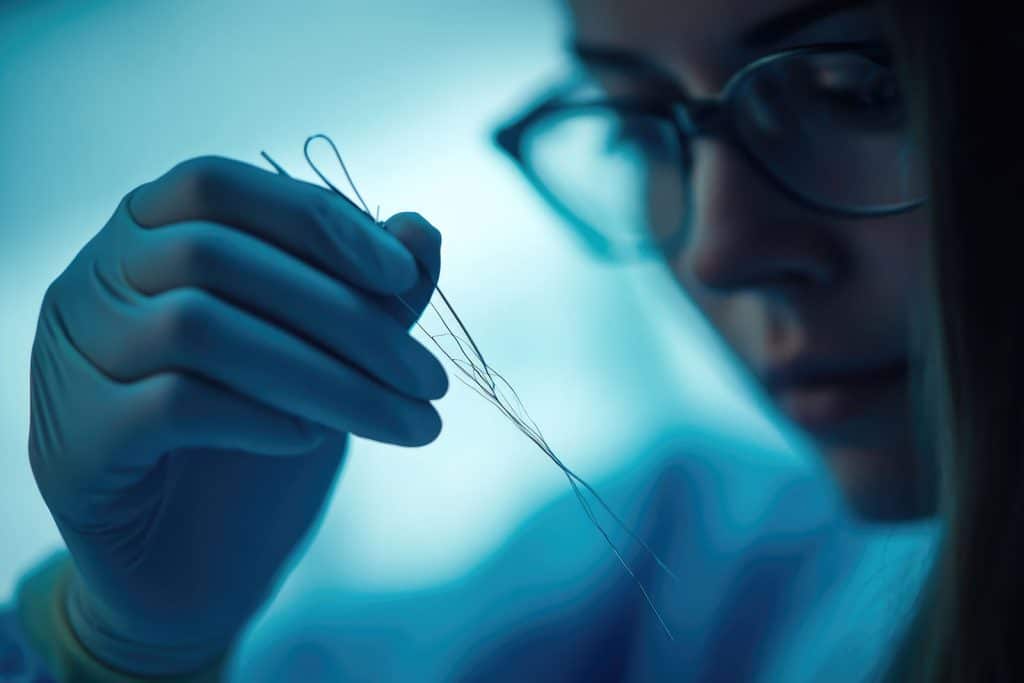
How Does a Hair Follicle Test Work?
When you use a drug like opiates, PCP, or THC, your body breaks it down into metabolites. Basically, metabolites are end-products of metabolism. Some of these metabolites travel through your bloodstream, end up in your hair follicles, and stay there for a few months.
As hair grows, they’re “locked” into the hair strands, like a time-stamped record of past substance use.
A hair follicle test checks for drug metabolites. Labs can screen for a specific drug or a panel of substances, depending on what’s being requested.
One of the biggest differences between hair testing and urine drug testing is the detection window.
Urine tests can catch very recent use, usually within 1–7 days. Hair tests, on the other hand, can show drug use over a longer detection window, typically around 90 days.
Why 90 days?
- Head hair grows at half inch per month on average.
- Most tests use 1.5 inches of hair from the scalp.
- A 1.5-inch hair sample equals 3 months of drug use history.
So, Can a Hair Follicle Test Detect Drug Use for a Full Year?
Possibly, but with caveats. It depends on the length of hair and other factors.
Say a person has 6 inches of head hair available. Roughly, that’s 12 months of growth. In theory, a lab could test the full 6 inches to look back a full year, however:
- Most testing labs only examine 1.5 inches of hair.
- Testing longer segments is less common.
- Older hair is a less reliable sample because of contamination, cosmetic damage, or degradation.
If a longer history is needed, labs might ask for longer hair. Body hair is another option, but it grows more slowly and irregularly.
When Can a Drug Test Go Back 12 Months?
Only a hair follicle test can potentially reach that far back, if the hair sample is long enough (6 inches at least). That said:
- Again, most labs do not test that far back.
- Drug type matters. Some drugs like amphetamines, methamphetamine, opioids, phencyclidine (PCP), and codeine are more reliably detected than others (like THC, which binds less efficiently to hair).
How Labs Analyze Hair Samples
Here’s how the testing method works. The lab personnel:
- Collects a sample of hair (about 100–120 strands) from near the scalp.
- Washes the hair sample to remove contaminants.
- Dissolves and tests the hair sample for drug metabolites using mass spectrometry or gas chromatography.
- Checks the cutoff level to determine a positive result. Anything below the cutoff yields a negative.
Note: Cutoff thresholds are set to avoid minor exposures and detect only actual drug use.
What Drugs Can Be Detected by a Hair Follicle Test?
A hair follicle drug test can detect various substances, including:
- Amphetamines (e.g., Adderall, methamphetamine)
- THC (marijuana)
- Opiates (e.g., codeine, morphine)
- Methadone
- Benzodiazepines (e.g., Xanax, Valium)
- Phencyclidine (PCP)
- Barbiturates
- Ketamine
- Fentanyl
- MDMA
Because drug metabolites embed in the hair, these substances can be picked up long after recent drug use ends.
What Are the Limitations of a Hair Follicle Test?
Hair follicle tests have the longest detection window, but there are certain limitations:
Hair follicle tests can’t detect drug use in the last few days. That’s because drugs need about 5–7 days for metabolites to be detectable.
So, someone could use drugs on Monday and potentially pass a hair test on Tuesday, while having a positive result from another type of drug testing. In contrast, a urine or saliva test can pick it up right away.
Also, hair tests are better at showing a heavy or regular pattern of use. If someone tried something once, especially weeks ago, it might not even register. The trace amount of metabolites can be too low to detect.

What Affects the Accuracy of a Hair Follicle Test?
Hair testing is reliable but not foolproof. Here’s what can skew test results:
1. Hair Treatments
Hair dye, bleach, and perms can degrade drug metabolites in the hair shaft. Chemically treating hair exposes it to strong chemicals, usually high-pH substances that can damage the hair structure. Drug metabolites leach out of the hair as a result.
Treated hair also becomes more porous, meaning it’s easier for outside contaminants (like smoke or dust) to settle in.
A study found some clear patterns:
- Drug levels are 30–60% lower in treated hair vs. untreated hair from the same person.
- For morphine, the drop is over 60%.
- For THC (marijuana) and nicotine, the drop is around 30%.
- Bleaching has the biggest impact
- Dyeing still has an effect, but not quite as much.
- The more damaged or over-processed the hair, the more it’s likely to show reduced results, even enough to trigger false negatives.
2. Melanin Levels
Believe it or not, your natural hair color can influence your drug test results.
Hair contains a pigment called melanin, which gives it color. Darker hair has more melanin, lighter hair has less. This pigment can affect how metabolites bind to your hair.
Research has shown that certain drugs, especially basic or lipophilic (fat-loving) ones like cocaine and amphetamines, attach more tightly to melanin.
That means two people could use the same drug, at the same time, in the same amount, and test differently because of their hair color.
3. Hair Growth Rate
How fast your hair grows and which part of the body it comes from can also affect results.
Labs prefer to use scalp hair, preferably from the back of the head (posterior vertex), as per Society of Hair Testing guidelines.
That area has the most consistent growth and the highest number of hairs in the active growth phase, which makes it the most reliable spot for testing.
If there isn’t enough scalp hair to work with (due to shaving, hair loss, etc.), labs may use body or facial hair, like from the arms, chest, or beard. However, body hair:
- Grows more slowly and more unpredictably than scalp hair.
- Spends more time in the resting phase, meaning they’re not actively growing.
This makes it harder to tell when a drug was actually used. You might get a general window of exposure, but not a clear time frame.
4. Environmental Contamination
Hair is like a sponge. It’s porous, and it’s constantly exposed to smoke, dust, powders, or even drug particles in the air.
So if you’ve been:
- In a room where people were smoking marijuana or crack,
- Around powdered cocaine,
- Or handling drugs without gloves,
… it’s possible for tiny drug particles to stick to your hair. This is known as external contamination. That’s why labs take extra steps to decontaminate the hair to avoid false positives.
Head Hair vs. Body Hair: Which Is Better for Hair Follicle Testing?
Head hair is preferred for drug screening because it grows consistently and provides a predictable detection window.
Body hair, on the other hand:
- Grows in cycles (not continuously).
- May contain drug metabolites from up to 12 months ago.
- Is used when head hair isn’t available.
But there’s a major limitation. Body hair doesn’t provide an accurate timeline. You’ll know if someone used drugs in the past year, but not when.
Why 12-Month Drug Tests Aren’t Common
Even though longer hair strands could theoretically capture a history of drug use up to a year, they’re rarely used in standard drug screening. Here’s why:
- Most employers and legal systems are only interested in the past 90 days.
- Longer detection windows increase the chance of picking up old, irrelevant drug use.
- The longer the length of hair, the greater the chance of degradation, chemical exposure, and environmental contamination.
- Without segmenting the hair (e.g., inch-by-inch analysis), it’s impossible to determine when drug use occurred.
Frequently Asked Questions (FAQs)
Can Hair Follicle Tests Detect Alcohol?
Can a Hair Test Show if I Used Drugs Only Once?
What information is included in a hair follicle drug test report?
To Wrap Up
So, can a hair follicle test go back 12 months? Sometimes, but with limitations.
Quick takeaways:
- Hair tests usually look back 90 days.
- Hair treatments and color can alter drug levels in the sample.
- Body and facial hair are backup options, but less precise.
Understanding how hair analysis works (and what influences test results) helps you see both its value and its flaws.
Written by: The Garden State Detox Editorial Team
Published on: July 31, 2025
Updated on: January 13, 2026